


The ‘X’ in REBAR-X stands for EpoXy, EXcellence, and EXtreme Durability.

EPOXY BAR
“The New Era of Corrosion
Free Reinforcement - REBAR-X"
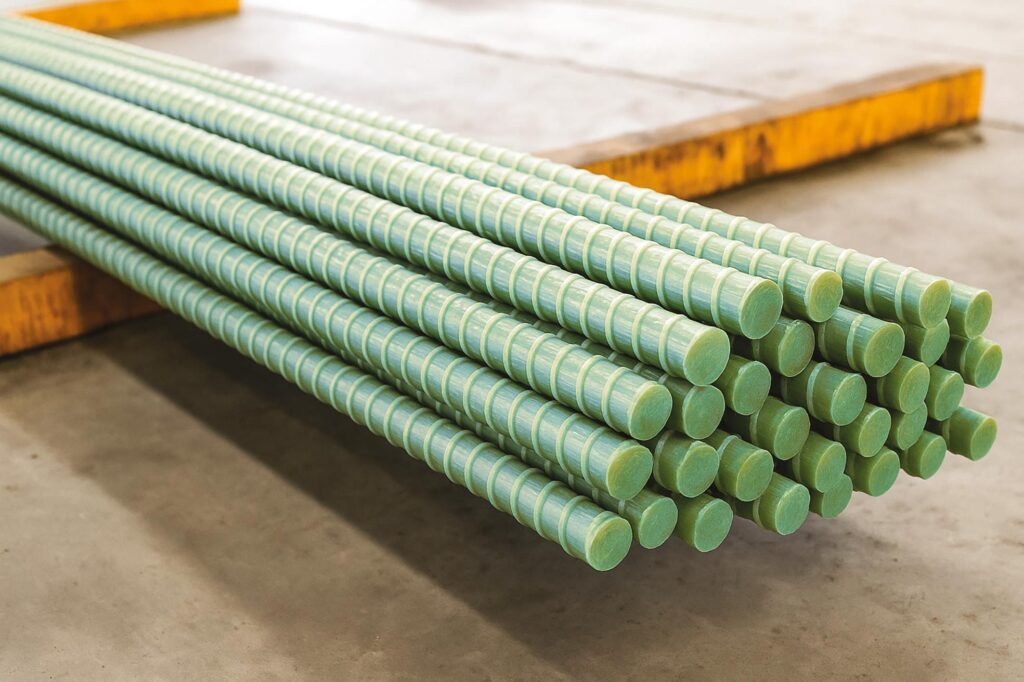
With advanced domestic manufacturing technology based on eco-friendly epoxy resin, we produce both the straight and ribbed sections through a fully automated electronic system to ensure the highest quality.
Comparison Table
Epoxy Bar vs. Steel Reinforcement Bar
Property
Steel Rebar
(SD400)
G-FRP
Vinyl ester
G-FRP
Epoxy
Steel
Rebar
7.85
7.85
G-FRP
(Vinyl ester)
1.9~2.2
1.9~2.2
G-FRP
(Epoxy)
1.9~2.2
1.9~2.2
Steel
Rebar
≥ 300 ~ 700
≥ 300 ~ 700
G-FRP
(Vinyl ester)
≥ 740~850
≥ 740~850
G-FRP
(Epoxy)
≥ 1,100~1,300
≥ 1,100~1,300
Steel
Rebar
200
200
G-FRP
(Vinyl ester)
45~60
45~60
G-FRP
(Epoxy)
45~60
45~60
Steel
Rebar
46.00
46.00
G-FRP
(Vinyl ester)
0.30
0.30
G-FRP
(Epoxy)
0.30
0.30
Steel
Rebar
10~14
10~14
G-FRP
(Vinyl ester)
≥ 15
≥ 15
G-FRP
(Epoxy)
≥ 15
≥ 15
Steel
Rebar
Susceptible to chloride-induced corrosion
Susceptible to chloride-induced corrosion
G-FRP
(Vinyl ester)
Non-corrosive; unaffected by chlorides
Non-corrosive; unaffected by chlorides
G-FRP
(Epoxy)
Non-corrosive; unaffected by chlorides
Non-corrosive; unaffected by chlorides
Steel
Rebar
Yes
Yes
G-FRP
(Vinyl ester)
No
No
G-FRP
(Epoxy)
No
No
Steel
Rebar
High
High
G-FRP
(Vinyl ester)
Low
Low
G-FRP
(Epoxy)
Low
Low
Steel
Rebar
Possible
Possible
G-FRP
(Vinyl ester)
Possible (Very weak bend)
Possible (Very weak bend)
G-FRP
(Epoxy)
Possible (Bending part strength 400MPa more)
Possible (Bending part strength 400MPa more)
Steel
Rebar
Possible
Possible
G-FRP
(Vinyl ester)
Not possible
Not possible
G-FRP
(Epoxy)
Not possible
Not possible
Vinyl Ester GFRP vs. Epoxy GFRP
Vinyl Ester GFRP
VS
Epoxy GFRP (E-CR glass)
Vinyl Ester
GFRP
10~20% lower tensile strength than epoxy
10~20% lower tensile strength than epoxy
Epoxy GFRP
(E-CR glass)
Higher tensile strength
Higher tensile strength
Vinyl Ester
GFRP
Average
Average
Epoxy GFRP
(E-CR glass)
Strong adhesion between fiber and resin
(excellent interfacial bonding)
Strong adhesion between fiber and resin
(excellent interfacial bonding)
Vinyl Ester
GFRP
Weaker tensile strength at bent areas
Weaker tensile strength at bent areas
Epoxy GFRP
(E-CR glass)
Excellent tensile strength retention at bent areas
Excellent tensile strength retention at bent areas
Vinyl Ester
GFRP
Excellent resistance to heat, chemicals, and alkali
Excellent resistance to heat, chemicals, and alkali
Epoxy GFRP
(E-CR glass)
Excellent resistance to heat, chemicals and alkali
Excellent resistance to heat, chemicals and alkali
Vinyl Ester
GFRP
Moderate
Moderate
Epoxy GFRP
(E-CR glass)
High glass-transition temperature (Tg) and superior moisture resistance
High glass-transition temperature (Tg) and superior moisture resistance
Vinyl Ester
GFRP
Unstable
Unstable
Epoxy GFRP
(E-CR glass)
Stable for mass production and automated molding (superior processability)
Stable for mass production and automated molding (superior processability)
Vinyl Ester
GFRP
Emits VOCs such as styrene and benzene
Emits VOCs such as styrene and benzene
Epoxy GFRP
(E-CR glass)
Excellent environmental safety and ESG performance (almost no emissions)
Excellent environmental safety and ESG performance (almost no emissions)
Vinyl Ester
GFRP
Average
Average
Epoxy GFRP
(E-CR glass)
Excellent surface finish and moldability
Excellent surface finish and moldability
Vinyl Ester
GFRP
Curing process shows variability
Curing process shows variability
Epoxy GFRP
(E-CR glass)
Stable curing process with minimal variability
Stable curing process with minimal variability
– Evaluated according to international standards such as ASTM D7205, ACI 440.1R, and CSA S806.